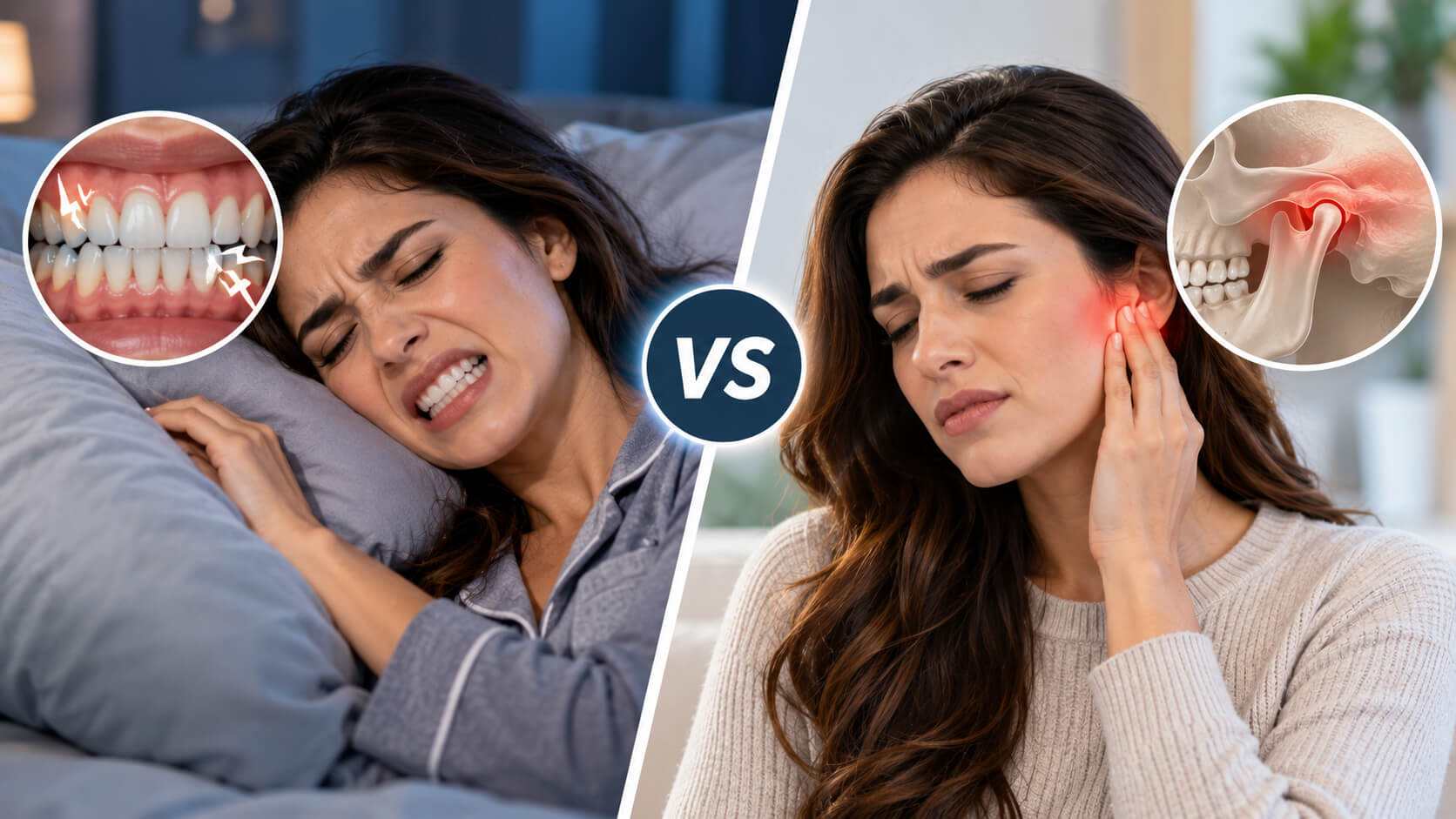

Bruxism is the habit of clenching or grinding your teeth, often during sleep, while TMJ disorder (TMD) is a problem with the jaw joint itself, causing pain, clicking, or limited movement. Bruxism can contribute to TMJ disorder over time. A dental exam at Friendly Dental of Somerset can help determine which condition applies to you and what treatment may help.
Why Is It Easy to Confuse These Two Conditions?
Jaw pain, morning headaches, and worn-down teeth are common complaints, and many patients searching for relief use the terms bruxism and TMJ disorder interchangeably. While the two conditions are closely related and often overlap, they are not the same thing, and the right treatment depends on which one, or both, is affecting you.
At Friendly Dental of Somerset, patients from Somerset, Franklin, Hillsborough, Bridgewater, Manville, New Brunswick, North Brunswick, South Brunswick, South Bound Brook, Milltown, and nearby communities often come in with jaw discomfort without knowing whether the cause is a grinding habit, a joint problem, or both. This guide breaks down the differences so you can better understand your symptoms before your consultation.
What Is Bruxism?
Bruxism refers to the repetitive clenching, grinding, or gnashing of teeth. It can happen while a person is awake (awake bruxism) or during sleep (sleep bruxism), and it often occurs without the person realizing it is happening.
What Are the Common Signs of Bruxism?
- Flattened, chipped, or worn tooth surfaces
- Increased tooth sensitivity
- A tired or tight feeling in the jaw muscles, especially in the morning
- Waking up with a dull headache
- A partner or family member noticing grinding sounds at night
- Indentations on the tongue or cheek tissue
Bruxism is generally considered a behavioral or habit-related condition, often linked to stress, anxiety, sleep patterns, or bite alignment. It may contribute to jaw joint strain over time, which is where the overlap with TMJ disorder begins.
What Is TMJ Disorder?
The temporomandibular joint (TMJ) is the hinge connecting your jawbone to your skull, located just in front of each ear. When this joint or the surrounding muscles are not functioning properly, the result is often referred to as TMJ disorder or temporomandibular dysfunction (TMD).
What Are the Common Signs of TMJ Disorder?
- Pain or tenderness near the jaw joint, ear, or side of the face
- Clicking, popping, or grating sounds when opening or closing the mouth
- Difficulty or discomfort while chewing
- A jaw that feels like it is locking or getting stuck
- Reduced range of motion when opening the mouth wide
- Facial pain that may radiate toward the neck or shoulders
Unlike bruxism, which is a behavior, TMJ disorder is considered a structural or functional joint issue. It can be caused by jaw injury, arthritis, joint misalignment, or ongoing muscle strain, and bruxism is one of several factors that may contribute to its development.
Bruxism vs TMJ Disorder Somerset NJ: Side by Side Comparison?
The table below highlights the core differences between bruxism and TMJ disorder so you can better describe your symptoms during a dental exam.
| Factor | Bruxism | TMJ Disorder (TMD) |
| Nature of the Condition | A behavior or habit (clenching/grinding) | A joint or muscle dysfunction |
| Primary Cause | Often stress, anxiety, or bite alignment | Joint injury, arthritis, muscle strain, or misalignment |
| Where It Occurs | Teeth and jaw muscles | The temporomandibular joint near the ear |
| Typical Symptoms | Worn teeth, jaw tightness, headaches | Clicking, locking, facial pain, limited jaw movement |
| When It Happens | Often during sleep, sometimes while awake | Can be constant or triggered by chewing/talking |
| Common Dental Treatment | Custom night guards or occlusal splints | Oral appliances, bite adjustment, physical therapy referral |
| Relationship | May contribute to TMJ disorder over time | May be worsened by untreated bruxism |
Note: Many patients experience both conditions together, since chronic grinding can place ongoing stress on the jaw joint. A dental exam is needed to determine the cause of your symptoms and the right treatment option.
Can Bruxism Cause TMJ Disorder?
Bruxism and TMJ disorder are considered separate conditions, but they are closely connected. Repeated clenching or grinding places extra pressure on the jaw joint and surrounding muscles, which may contribute to inflammation, discomfort, or joint dysfunction over time. In the same way, an existing TMJ disorder can make a person more likely to clench or grind as the jaw tries to find a more comfortable position.
This overlap is why an accurate diagnosis matters. Treating only the teeth without addressing the joint, or the joint without addressing the grinding habit, may not fully resolve your symptoms.
How Are Bruxism and TMJ Disorder Diagnosed?
At Friendly Dental of Somerset, Dr. Sandeep Kaur, DDS evaluates your bite, jaw movement, muscle tenderness, and tooth wear patterns during a comprehensive exam. Diagnosis typically involves:
- A review of your symptoms, sleep habits, and stress levels
- A visual and physical exam of tooth wear, gum recession, and jaw alignment
- Listening for clicking, popping, or grating sounds in the jaw joint
- Checking your range of motion when opening and closing your mouth
- Discussing whether pain radiates to the ears, temples, or neck
A dental exam is needed to determine the cause of your symptoms and the right treatment option. Self-diagnosing based on symptoms alone is not recommended, since bruxism, TMJ disorder, and other conditions like sinus issues or tooth infections can sometimes present similarly.
Which Treatment Do You Need?
Treatment depends on which condition, or combination of conditions, is affecting you, and how severe your symptoms are. Options may include:
What Helps With Bruxism?
Custom-fitted night guards or occlusal splints are the most common approach, designed to protect teeth from further wear and reduce grinding-related strain. Learn more about our bruxism treatment services in Somerset, NJ.
What Helps With TMJ Disorder?
Treatment for TMJ disorder may include oral appliances, bite adjustments, guided jaw exercises, or a referral for further evaluation depending on severity. Explore our dedicated TMD/TMJ treatment page for a closer look at how we approach jaw pain relief.
What If Both Conditions Overlap?
If bruxism and TMJ disorder are both present, a combined approach, such as a night guard designed to also stabilize the bite, may be recommended. Some patients undergoing Invisalign clear aligner treatment also ask whether it affects grinding or jaw symptoms. This is a fair question to raise during your Invisalign consultation with Dr. Kaur, a Certified Platinum Invisalign Provider, so your treatment plan can account for it.
When Should You See a Dentist Right Away?
While most bruxism and TMJ symptoms develop gradually and are not emergencies, certain signs warrant prompt attention:
- A jaw that suddenly locks and will not open or close
- Severe facial pain that does not improve with rest
- Jaw pain following an injury or trauma
- Swelling in the jaw or face area
- Sudden changes in your bite that make chewing difficult
If you are experiencing severe pain, facial swelling, uncontrolled bleeding, trauma, fever, or signs of infection, seek urgent dental or medical care immediately. Call Friendly Dental of Somerset at +1 855-960-3860 for guidance during business hours.
Why Do Somerset, NJ Patients Trust Friendly Dental for Jaw Pain and Grinding Concerns?
Friendly Dental of Somerset is a patient-first dental practice led by Dr. Sandeep Kaur, DDS, a graduate of NYU College of Dentistry and an active member of the American Dental Association (ADA), the New Jersey Dental Association (NJDA), and the Middlesex County Dental Society. The practice offers:
- A comprehensive evaluation to distinguish between bruxism, TMJ disorder, or both
- Custom night guards and bite-focused treatment planning
- English and Spanish-speaking staff for comfortable communication
- A warm, non-judgmental environment for patients with dental anxiety
- Comprehensive care under one roof, from preventive visits to cosmetic and Invisalign treatment
To see the full range of services offered alongside bruxism and TMJ care, visit our dental services page, or explore our comprehensive dental services in Somerset, NJ overview.
Frequently Asked Questions
Schedule Your Consultation Today?
If you are dealing with jaw pain, teeth grinding, or clicking sounds when you chew, Friendly Dental of Somerset can help determine whether bruxism, TMJ disorder, or both are behind your symptoms. Call +1 855-960-3860. to request an appointment, or visit our contact page to get started. English and Spanish-speaking staff are available to assist you.
Disclaimer
This content is for general educational purposes only and is not a substitute for a dental exam, diagnosis, or personalized treatment plan. Please schedule a consultation with Friendly Dental of Somerset or contact a qualified dental professional for advice specific to your oral health. If you are experiencing severe pain, facial swelling, uncontrolled bleeding, trauma, fever, or signs of infection, seek urgent dental or medical care immediately.