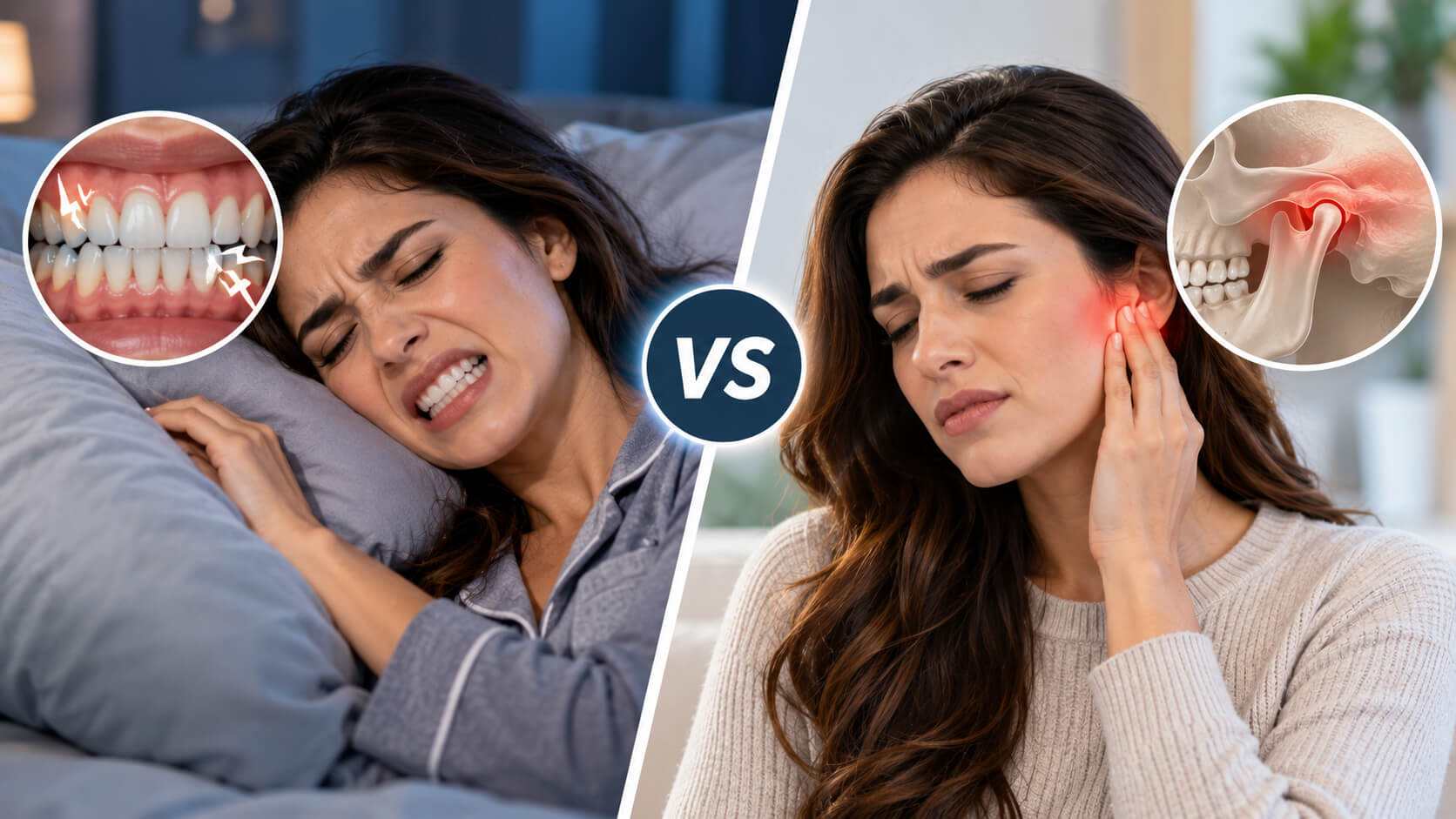

Bruxism is the involuntary grinding or clenching of teeth — most often during sleep — while TMJ disorder (TMD) refers to dysfunction in the temporomandibular joint that connects your jaw to your skull. Although they are distinct conditions, untreated bruxism is one of the leading causes of TMJ disorder. Many patients in Collierville, TN have one, the other, or both simultaneously. A comprehensive dental evaluation is the only way to get an accurate diagnosis and the right treatment plan.
What Is the Difference Between Bruxism and TMJ Disorder?
Bruxism is the involuntary grinding or clenching of teeth — often during sleep — while TMJ disorder (TMD) refers to dysfunction in the temporomandibular joint that connects your jaw to your skull. Although they are two distinct conditions, they are deeply connected: untreated bruxism is one of the most common causes of TMJ disorder, and patients in Collierville are frequently confused about which condition they have — or whether they have both.
Understanding the difference is critical. Treating a TMJ disorder without addressing underlying bruxism often leads to recurring symptoms. This guide breaks down both conditions side by side so you can walk into any Collierville dental appointment informed and ready to get the right care.
Bruxism Explained: The Teeth Grinder’s Guide
Bruxism is classified as a sleep-related movement disorder when it occurs at night (sleep bruxism) or a parafunctional habit when it occurs during the day (awake bruxism). Stress, anxiety, certain medications, and sleep apnea are the most consistently identified triggers.
Common Signs You May Have Bruxism
- Worn, flattened, or chipped tooth surfaces
- Increased tooth sensitivity — especially to hot and cold
- Audible grinding sounds noticed by a bed partner or caregiver
- Morning jaw soreness or muscle fatigue
- Frequent tension headaches, particularly at the temples
- Indentations on the sides of your tongue
- Cracked or fractured teeth without a clear cause
Bruxism is often a silent condition — many patients do not realize they grind their teeth until a dentist identifies visible enamel wear during a routine exam. Left untreated, chronic bruxism causes irreversible tooth damage, gum recession, and places excessive stress on the temporomandibular joint, setting the stage for TMJ disorder.
TMJ Disorder Explained: When the Jaw Joint Breaks Down
The temporomandibular joints (TMJ) are the two hinged joints on either side of your face that allow you to open, close, and move your jaw for speaking, chewing, and swallowing. TMJ disorder (officially termed temporomandibular disorder, or TMD) is an umbrella term for conditions affecting these joints, the surrounding muscles, and the connective tissue.
TMJ disorder can be caused by bruxism, jaw injury, arthritis, bite misalignment, or prolonged stress on the joint. In Collierville and across Shelby County, jaw pain is among the most underdiagnosed dental complaints — primarily because patients often attribute the symptoms to tension headaches or ear infections.
Common Signs You May Have TMJ Disorder
- Clicking, popping, or grinding sounds when opening or closing the jaw
- Jaw locking — difficulty opening the mouth fully
- Pain or tenderness in front of the ears or along the jaw
- Facial pain that radiates toward the neck or shoulders
- Ear pain or a sensation of fullness in the ears without infection
- Difficulty chewing or a sudden change in how your teeth fit together
- Chronic headaches and migraines that do not respond to standard treatment
Bruxism vs. TMJ Disorder: Side-by-Side Comparison
|
Feature |
Bruxism |
TMJ Disorder (TMD) |
|
Definition |
Involuntary teeth grinding/clenching |
Dysfunction of the jaw joint and surrounding muscles |
|
Primary cause |
Stress, anxiety, sleep disorders |
Bruxism, injury, arthritis, bite misalignment |
|
Main symptoms |
Worn teeth, jaw soreness, headaches |
Jaw clicking, locking, facial/ear pain |
|
Occurs when |
Mostly during sleep |
Any time jaw is used |
|
Diagnosed by |
Dental exam, tooth wear patterns |
Dental exam, imaging (X-ray/CBCT) |
|
Treated with |
Night guard, stress management, Botox |
Splint therapy, physical therapy, lifestyle changes |
|
Can cause the other? |
Yes — bruxism leads to TMJ damage |
Yes — TMD alters bite, worsening grinding |
|
Reversible? |
Partially (tooth damage is permanent) |
Often manageable; advanced cases need specialist care |
Can You Have Both Bruxism and TMJ Disorder at the Same Time?
Yes — and this is far more common than most patients expect. When bruxism is left untreated for months or years, the repetitive mechanical pressure on the temporomandibular joint degrades the cartilage disc that cushions the joint, inflames the surrounding muscles, and pulls the joint out of alignment. The result is a dual diagnosis: active bruxism that continues to cause tooth wear, combined with an inflamed or displaced TMJ that generates chronic jaw pain, clicking, and headaches.
Patients with this dual presentation often report that their symptoms escalate over time — what began as occasional morning jaw soreness becomes daily facial pain, then restricted jaw movement. If you recognize symptoms from both columns above, it is strongly advisable to seek a comprehensive dental evaluation as soon as possible rather than treating one condition in isolation.
How a Collierville Dentist Diagnoses and Differentiates Both Conditions?
An experienced Collierville dentist will use a multi-step evaluation protocol:
- Comprehensive dental exam — Visual inspection of all tooth surfaces for wear facets, enamel erosion, and fracture lines consistent with chronic grinding.
- Occlusal analysis — Assessment of how upper and lower teeth meet (bite alignment) to identify stress points.
- Joint palpation — Manual examination of the TMJ area for tenderness, swelling, or crepitus.
- Jaw range of motion test — Measuring how wide you can open your mouth and whether deviation or restriction is present.
- Digital X-rays or CBCT imaging — To visualize the jaw joint structure, identify arthritic changes, or rule out other causes of jaw pain.
- Sleep and stress history — A detailed patient history exploring sleep quality, stress levels, medications, and lifestyle habits.
Treatment Options: Bruxism and TMJ Disorder
Treating Bruxism
The most established front-line treatment for bruxism is a custom-fitted night guard (also called an occlusal splint). Unlike store-bought guards, a professionally fabricated night guard is precision-molded to your exact bite, distributing grinding forces evenly and preventing direct tooth-to-tooth contact. Custom guards are significantly more comfortable than over-the-counter alternatives, which increases patient compliance and long-term effectiveness.
Additional bruxism treatment options include:
- Stress management and behavioral therapy — addressing anxiety, the most common psychological trigger for bruxism
- Sleep apnea treatment — patients with obstructive sleep apnea exhibit significantly higher rates of sleep bruxism; treating sleep-disordered breathing frequently reduces grinding
- Masseter Botox injections — small amounts of botulinum toxin injected into the masseter muscles to reduce their force of contraction; particularly effective for awake bruxism and refractory cases
Treating TMJ Disorder
- Occlusal splint therapy — a stabilizing splint repositions the jaw to reduce joint stress; often the first-line treatment
- Physical therapy — targeted jaw exercises, ultrasound therapy, and trigger-point massage to relieve muscle tension and improve joint mobility
- Anti-inflammatory medications — NSAIDs or corticosteroid injections to manage acute flare-ups
- Bite correction — dental procedures such as selective bite adjustment, orthodontics, or restorations for chronic bite misalignment
- Surgical intervention — reserved for advanced cases involving disc displacement or joint degeneration unresponsive to conservative care
The Stress–Bruxism–TMJ Cycle: Breaking the Loop
One of the most clinically important insights in modern dentistry is that bruxism, TMJ disorder, and chronic stress exist in a self-reinforcing cycle. Psychological stress increases bruxing activity, which inflames the TMJ, which creates chronic pain, which elevates stress hormones — perpetuating the grinding. Breaking this cycle requires treating all three components simultaneously rather than addressing them sequentially.
This is why Collierville patients who report only jaw clicking should still be screened for bruxism, and those presenting with tooth wear should receive a TMJ evaluation as a standard part of their care. A holistic, whole-jaw approach — combining protective appliances, lifestyle modification, and joint therapy — produces the best long-term outcomes.
When to See a Dentist: Red Flags That Cannot Wait?
Seek dental care promptly if you experience any of the following:
- Jaw that locks open or closed, even temporarily
- Sudden change in how your teeth fit together (bite shift)
- Tooth sensitivity that appeared without a known cause
- Visible flat or worn tooth surfaces noted in the mirror
- Clicking or popping sounds accompanied by pain
- Chronic headaches that radiate from the jaw toward the ear or temple
- Noticeable tooth grinding sounds reported by a family member or partner
Early intervention is the single most important factor in preventing permanent joint damage and irreversible tooth loss. The longer bruxism and TMJ disorder go untreated, the more complex — and costly — the path to recovery becomes.
Take the Next Step: Get a Comprehensive Jaw Health Evaluation
If you are experiencing any symptoms of bruxism or TMJ disorder — worn teeth, morning jaw pain, clicking sounds, or chronic headaches — a comprehensive dental evaluation is the most important step you can take for your long-term oral health. A qualified Collierville dentist can differentiate between the two conditions, identify whether they co-exist, and build a personalized treatment plan that protects your teeth, relieves your pain, and stops the damage cycle before it progresses further.
Do not wait until symptoms become severe or irreversible dental damage occurs. Early diagnosis and treatment preserve both your smile and your quality of life.
This article is for informational purposes only and does not constitute medical or dental advice. Please consult a licensed dental professional for diagnosis and treatment.
Frequently Asked Questions (FAQs)